

About Client
Ultimation Industries LLC has been a leader in conveyor technologies and automation for nearly 30 years and has grown into one of the major conveyor manufacturers in the USA. The company’s core capabilities are built around conveyor technologies and automation systems.
Founded in 1988, Ultimation has a strong history of serving customers across the United States, Latin America, and Europe. Its executive leadership team brings decades of experience in designing and building high-performance assembly line equipment, making them experts in conveyor technology and automation.
- More than 50+ team members and 1000+ customers and vendors required an efficient system to manage business operations
- https://www.ultimationinc.com
Project Background
The requirement was to move to a more robust and efficient system covering core business modules. The client needed a solution that was easy to use, manage, and capable of supporting existing functionalities along with additional capabilities.
Peritos helped align business requirements with processes, and Microsoft Business Central emerged as the ideal solution to migrate from the legacy system, SAGE-50 (on-premise).
Requirement
- Defined core modules during the initial requirement gathering phase to map existing business processes
- Integration with multiple eCommerce platforms such as WooCommerce and Amazon
- Resolve taxation challenges where taxes were previously managed manually
Scope and Feature List
- Implementation of modules as defined during the scoping phase
- Sales: Quotes, Orders, Invoices, and Shipments
- Purchasing: Purchase Orders, Receipts, and Invoices
- Bank reconciliation
- Finance: Chart of Accounts, General Ledger, Payment Reconciliation
- Reporting
- Inventory management and item-based MRP
- Integration scenarios via eBridge for automated sales order creation and invoicing
- Integration with Avalara for taxation
- Migration of open balances (Customer, Vendor, GL accounts)
- Migration of master data (Customers, Vendors, Contacts, Items)
- Migration of open transactions (Purchase Orders, Sales Orders, Draft Invoices)
Implementation
Technology and Architecture
- System Version: Business Central online version with essentials and Team licenses for up to 20 users.
- Legacy System: Data was migrated from legacy system Sage.
- Enabled logs and ledger entries to follow accounting best practices.
- Reporting and integration with Power BI for better business visibility.
- Custom Coding:
- Convert sales orders to sales invoices
- Number series automation
- UI customizations
- Reporting fields
- Data mapping and integration of legacy system with Business Central
- Security considerations:
- Database encryption
- Multi-factor authentication
- Tokenized API endpoints for WooCommerce integration
- Permission-based access for user groups
Challenges & Solutions
- Migrating master and transactional data from Sage was challenging due to unstructured data.
- Developed an internal system for multiple data transfers and conducted mock go-live twice.
- Key user training ensured a smooth go-live and coverage of all business scenarios.
- Scenario-based training with checklists, video recordings, and user guides.
- Handled specific cases like placeholder invoices before actual vendor invoices arrived.
- Customized solution to update invoice numbers after receiving actual vendor invoices.
Benefits to the Client
- Discounted license pricing
- Free Business Central instance for more than 5 months during implementation
- 1 month go-live support included, plus 2 weeks extended support
- No cost overruns, maintained tight budget and schedule
- Access to Microsoft partner network with direct escalation for outages and high-priority issues
Support
As part of the project implementation, we provided 1 month of extended support, including major and minor bug fixes.
Next Phase
We are now looking at the next phase of the project which involves:
- Ongoing support and adding new features based on client requirements, including customizations and standard features like automatic reconciliations and invoice payment matching automation
- Planning to add another company to the Business Central instance as part of the group
- Implementing the warehouse module for better control over inventory movements

About Client
AWS Environment Setup
Tonkin + Taylor is New Zealand’s leading environment and engineering consultancy with offices located globally. They shape interfaces between people and the environment which includes earth, water and air. They have won awards like Beaton Client Choice Award for Best Provider to Government and Community-2022 and IPWEA Award for Excellence in Water Projects for the Papakura Water Treatment Plan- 2021.
- https://www.tonkintaylor.co.nz/
- Location: New Zealand
Project Background
Tonkin + Taylor were embarking on the journey for launching a full suite of digital product and zeroed upon AWS as thier choice for cloud environment. They wanted to create new applications and migrate to cloud services to improve their scalability, ensure availability, minimize latency and reduce costs. They were also looking to accelerate their digital transformation and add greater business value through AWS Development Environment best practices. Lastly with the new apps they wanted to monetize and create SAAS based offerings for the end users. For all this it was needed to do AWS Environment Setup which follows best practices and meets compliance which can be used as a base for implementing more applications.
Scope & Requirement
In the 1st Phase of the AWS Environment Setup, implementation was discussed as follows:
- Setting up AWS environment for multi account, Multi environment setup
- Ensure the all AWS accounts follow same set of policies and adhering to all legal and regulatory compliance.
- Setup connectivity between different AWS accounts and on-prem network
- Setup AWS security hub to provide a comprehensive view of security state
- The Tonkin + Taylor On-Premise to Cloud Migration project aims to modernize and optimize the company’s IT infrastructure by migrating its existing on-premise systems to a cloud-based environment. The key objectives include reducing operational costs, enhancing scalability, improving system performance, and ensuring business continuity through a secure, reliable, and accessible cloud platform.
Implementation
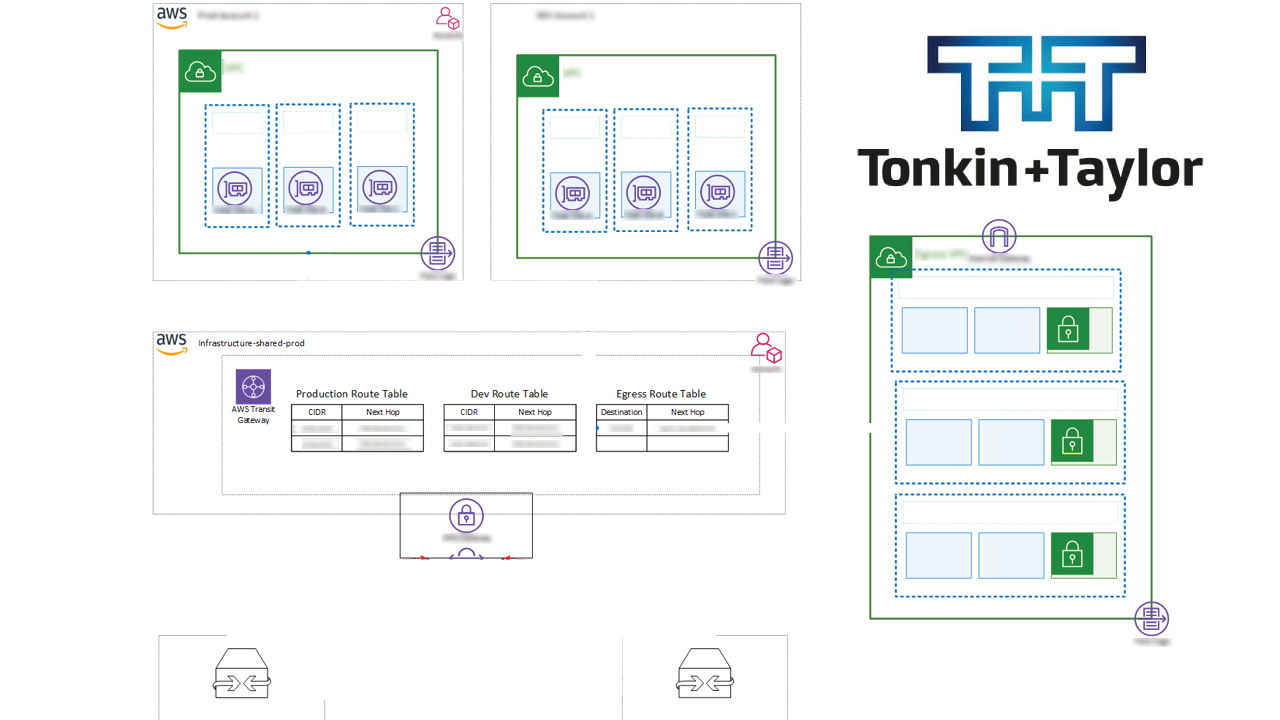
Technology and Architecture
Read more on the key components which defined the Architecture for AWS Environment Setup for Tonkin + Taylor
Technology/ Services used
- We used AWS services and helped them to setup below
- Cloud: AWS
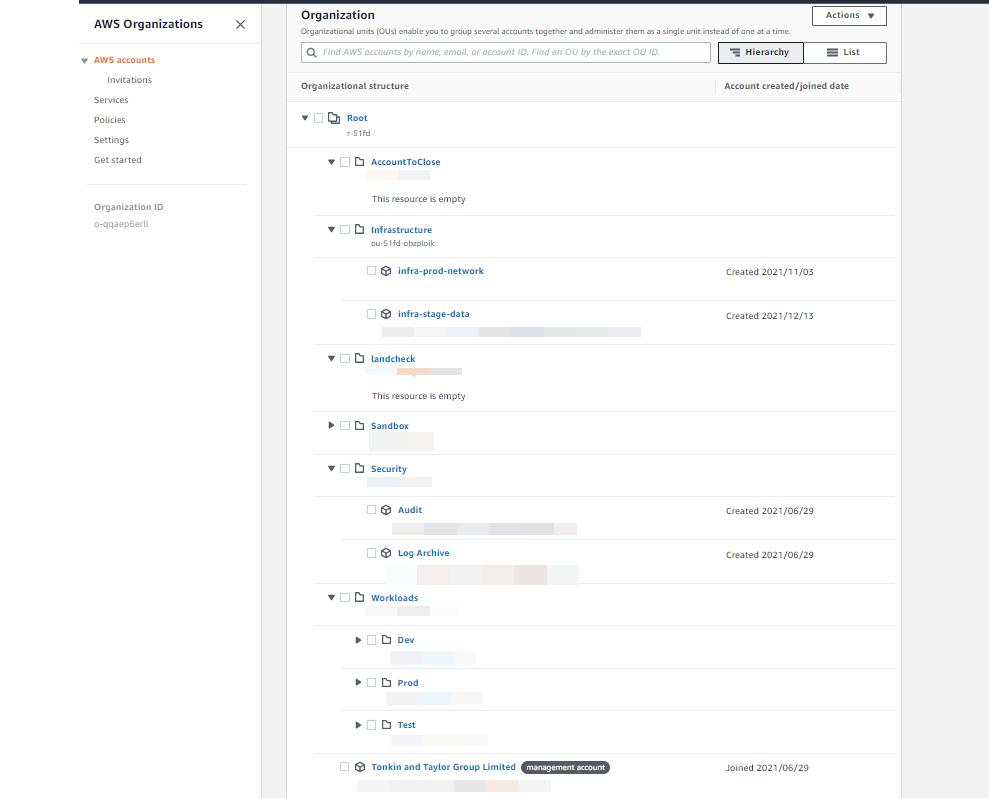
- Organization setup: Control tower
- AWS SSO for authentication using existing AzureAD credentials
- Policies setup: Created AWS service control policies
- Templates created for using common AWS services
Security & Compliance:
- Tagging Policies
- AWS config for compliance checks
- NIST compliance
- Guardrails
- Security Hub
Network Architecture
- Site to Site VPN Architecture using Transit Gateway
- Distributed AWS Network Firewall
- Monitoring with Cloud Watch and VPC flow logs.
Backup and Recovery
Cloud systems and components used followed AWS’s well-Architected framework and the resources were all Multi-zone availability with uptime of 99.99% or more.
Cost Optimization
Alerts and notifications are configured in the AWS cost
Code Management, Deployment
Cloudformation scripts for creating stacksets and scripts for generating AWS services was handed over to the client
Challenges of AWS Environment Setup
- It was a bit of a challenge to ensure the new environment meets all of the compliance criteria and still remain cost effective.
- As per best practices we need to have a set of Unique machines and each may need to have its own VPC but that may incur a cost to the client. So we discussed and agreed for a specific 75% to be achieved which would be deemed as acceptable
- We have some non compliance being generated by standard AWS services
- We got below feedback from AWS support . “It was reported that there are some policies and roles which are created by control tower and are created using best practices and there is no harm or security issue which arises it. Sometimes the conformance pack you use does shows the by default created policies to be non-compliant and you can ignore that for the time being. To make it compliant we have to either delete or the modify these roles/policies and since these roles and policies managed by the Control Tower, it is recommended not to manually update/delete the roles attached. Diving deeper into the issue, I could refer that the Control Tower managed artifacts feature heavily on the compliance failure list and there is no way to specifically exclude Control Tower managed artifacts from the compliance checking. Checking further with the internal team, I found that they are aware of the issue and there has been an ongoing feature request to exclude Control Tower managed artifacts from the compliance checking to avoid these such security findings. ” So based on this feedback we ensured to make a note that the non compliance being shown may not be an accurate one and these would be treated as exceptions.
Support
- 1 month extended support
- A template for Cloud formation stack to create more AWS resources using the available stacks
- Screen sharing sessions with demo of how the services and new workloads can be deployed.
- Offer support during the initial transition phase post-migration.
- Provide ongoing technical support, monitoring, and optimization services.
Next Phase
We are now looking at the next phase of the project which involves:
- Launching new digital products with the help of AWS environments which have been setup
- Any adhoc change requests for managing the cloud environment
About Client
AWS Control Tower Setup
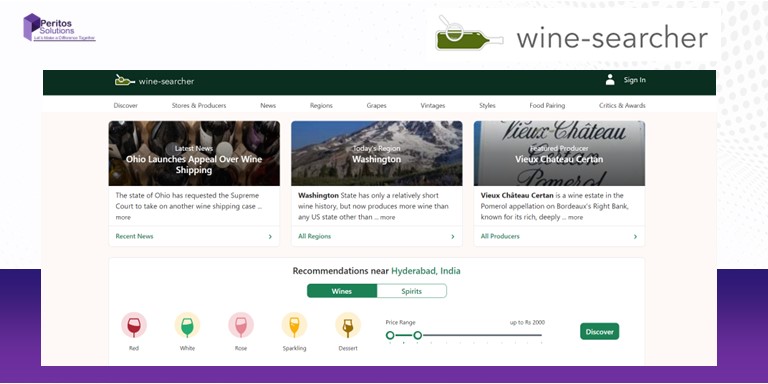
Wine-Searcher is a web search engine that helps find the price and availability of wine, whiskey, spirits, and beer worldwide.
It has been operating since 1999, with offices in New Zealand and the UK. The platform offers search tools, price comparison,
an extensive database, an encyclopedia, and news content to support all wine-finding needs.
- https://www.wine-searcher.com/
- Location: New Zealand & UK
Project Background
Peritos led the AWS Control Tower setup for Wine-Searcher, optimizing their cloud infrastructure.
The implementation streamlined governance, improved compliance, and enabled secure scalability.
Multiple accounts were consolidated and managed using AWS Organizations within Control Tower.
The environment was configured to meet specific business needs, ensuring efficient resource management
and cost control. With built-in automation and governance, Wine-Searcher gained a strong foundation
for future growth while focusing on innovation and user experience.
Scope & Requirement for AWS Control Tower Setup
- Prerequisite: Automated pre-launch checks for the management account
- Step 1: Create shared account email addresses
- Define expectations for landing zone configuration
- Step 2: Configure and launch the landing zone
- Step 3: Review and finalize the landing zone setup
Implementation
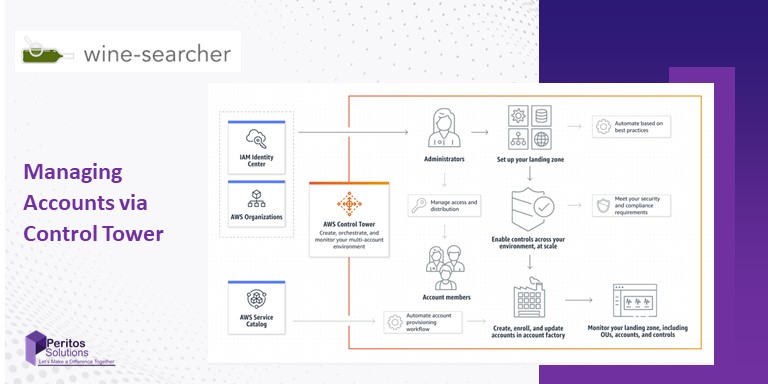
Technology and Architecture of AWS Control Tower Setup
- Read about the key components defining the AWS Control Tower architecture for Wine-Searcher
Technology / Services Used
- We used AWS services to set up the following:
- Cloud: AWS
- Organization setup: Control Tower
- AWS SSO integrated with Azure AD credentials
- Policies setup: AWS Service Control Policies (SCPs)
- Templates created for common AWS services
Security & Compliance
- Tagging policies
- AWS Config for compliance checks
- NIST compliance
- Guardrails
- Security Hub
Network Architecture
- Site-to-site VPN using Transit Gateway
- Distributed AWS Network Firewall
- Monitoring with CloudWatch and VPC Flow Logs
Backup and Recovery
- Infrastructure follows AWS Well-Architected Framework with multi-zone availability and 99.99% uptime
Cost Optimization
Alerts and notifications are configured to monitor AWS costs and prevent budget overruns.
Code Management & Deployment
CloudFormation scripts for stack sets and AWS service provisioning were handed over to the client.
Challenges in Implementing AWS Control Tower Setup
- Landing Zone Drift
- Role Drift
- Security Hub Control Drift
- Trusted Access disabled
Support
- 1 month extended support
- A template for Cloud formation stack to create more AWS resources using the available stacks
- In addition, Screen sharing sessions with demo of how the services and new workloads can be deployed.