


About the Client
| Client | Bayleys Real Estate |
| Industry | Commercial & residential property | sales · valuation · property management |
| Region | New Zealand | one of NZ’s largest full-service real estate companies |
| Application | CVE — Commercial Valuation Evidence | internal property evidence platform |
| Legacy | Microsoft Access database → migrated to Aurora PostgreSQL on AWS |
| Delivered by | Peritos Solutions | Oct 2023 – Dec 2023 |
Bayleys is one of New Zealand’s leading full-service real estate companies, operating across commercial, industrial, residential and rural property. Their internal CVE application is used by valuers to record, search, and report on commercial sales and rental evidence across the New Zealand market.
Project Background
Bayleys’ existing Commercial Valuation Evidence system ran on a legacy Microsoft Access database — a standalone, desktop-bound solution with no cloud access, no modern search capability, and no ability to scale to a growing user base. The requirement was to migrate the entire application to a cloud-native platform that could be accessed from any device, support role-based access aligned to Bayleys’ existing Azure AD identity, and provide a significantly improved user experience for valuers entering and searching property evidence.
Peritos Solutions was engaged to design, build, and deploy the full application on AWS — from architecture design and Access database migration through to a React.js frontend, serverless C# API layer, Aurora PostgreSQL database, and production deployment — in under two months.
Project Timelines
| Phase | Period | Key Activities | Status |
| Phase A | Oct 2023 | Requirement gathering, AS IS / TO BE flows, business architecture, application design, AWS account structure setup (Dev/Test/Prod OUs) | Done |
| Phase B | Oct – Nov 2023 | AWS infrastructure setup, React.js frontend, C# Lambda APIs, AWS Cognito + Azure AD SSO, property search, sales entry, rental entry, photo/attachment upload, CI/CD pipelines, unit testing | Done |
| Phase C | Nov – Dec 2023 | Word/Excel export, Google Maps radius search, audit logs, email report delivery, advanced search enhancements | Done |
| Phase D | Dec 2023 | Access DB data migration to Aurora PostgreSQL, UAT, bug fixing, production deployment, documentation & handover | Done |
| Hypercare | Dec 2023 | 1-month free hypercare post go-live, then transition to support contract | Done |
Results & Impact
Observability & Visibility
Assessment Report
Phase A delivered a structured assessment before any build commenced:
- Risk & Gap Analysis — AS IS Access database reviewed, TO BE cloud architecture designed, data migration approach confirmed, and AWS account structure (Dev/Test/Prod organisation units) set up before development started
- Customised Assessment Report — AWS Well Architected Framework assessment completed across all five pillars (Operational Excellence, Security, Reliability, Performance Efficiency, Cost Optimisation), with adherence built into the architecture from day one
- Pricing validated — full AWS pricing model confirmed at USD $124.22/month (Asia Pacific Sydney) before infrastructure was provisioned
Cloud Formation
Serverless AWS Architecture
The entire application was built on a consumption-based serverless model:
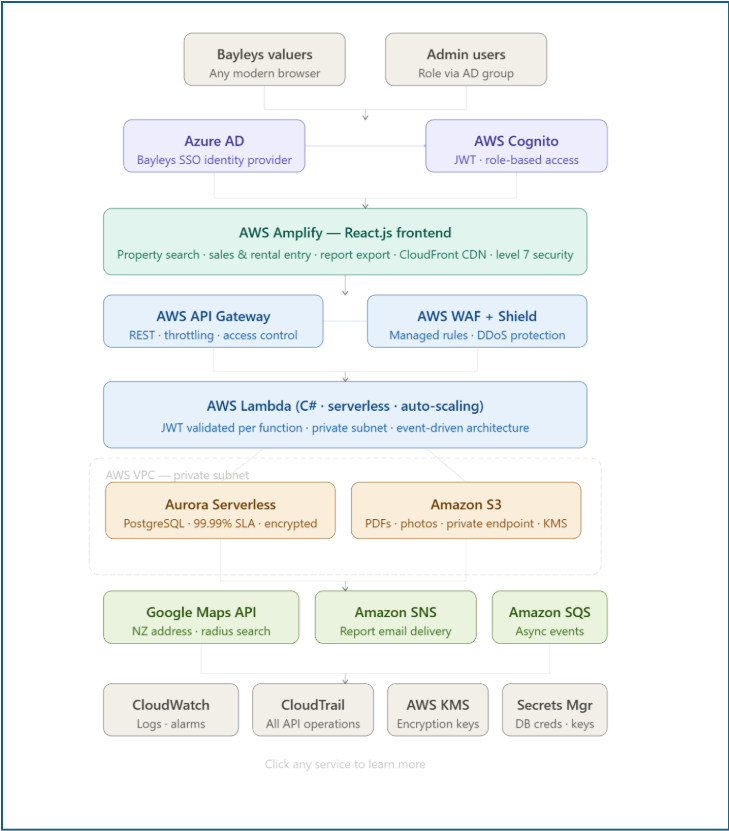
- AWS Lambda (C#) — all backend APIs run serverless with automatic scaling, zero server management, and 99.95% SLA
- Aurora Serverless PostgreSQL — database scales automatically with demand, 99.99% SLA, deployed in a private subnet with no public internet access
- AWS Amplify — React.js frontend deployed on a managed CloudFront distribution with built-in level 7 security — no additional CDN or WAF configuration required for the frontend
- CloudFormation IaC — all three environments (Dev/Test/Prod) provisioned from identical infrastructure-as-code scripts, ensuring full environment parity
Scope & Requirements
Phase A — Requirements & Architecture
- AS IS and TO BE process flows documented for sales and rental evidence workflows
- AWS account structure designed — separate Dev, Test, and Prod accounts under an Organisation Unit hierarchy
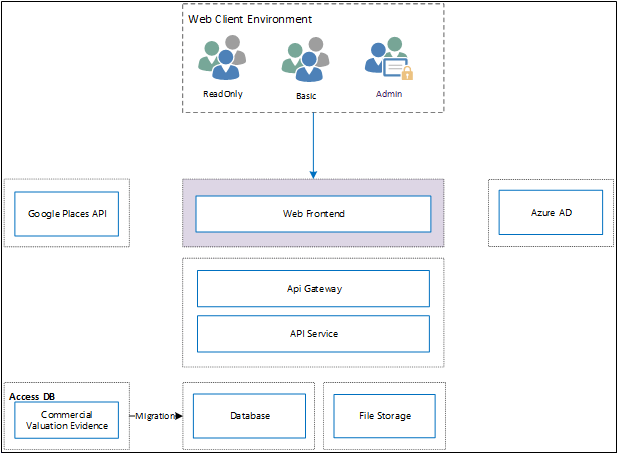
- Application architecture designed — serverless, multi-layer (Presentation · Business Services · Data Access)
- AWS Well Architected Framework review completed across all 5 pillars
- AWS pricing model confirmed — USD $124.22/month
Phase B — Core Application
- AWS infrastructure setup — VPC, private subnets, CloudFormation scripts, CI/CD pipelines
- User authentication — AWS Cognito with Azure AD as identity provider; JWT token validation on every Lambda; admin/user role assignment from AD groups
- Home screen and navigation — role-based dashboard
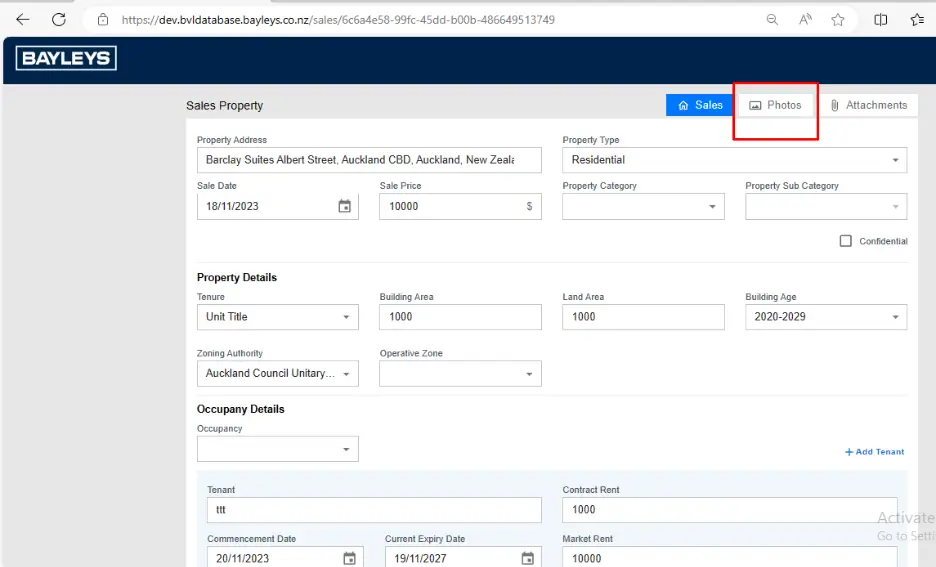
- Commercial Valuation Evidence (CVE) module — full sales evidence entry with NZ address restriction
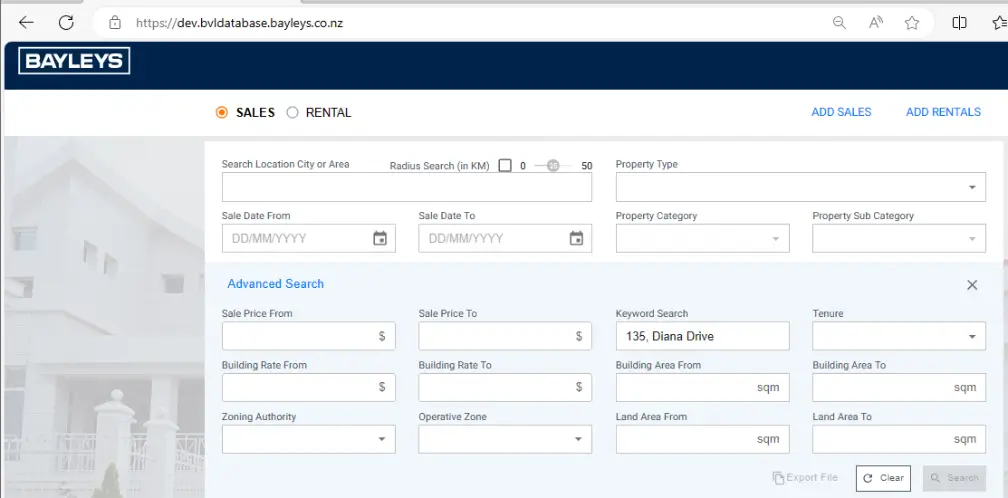
- Property search — by type, category, subcategory, location, date range, price, building area, tenure, zoning, keyword
- Rental Assessment module — rental entry with auto-calculated annual rental (area × contract rate), lease terms, occupancy details
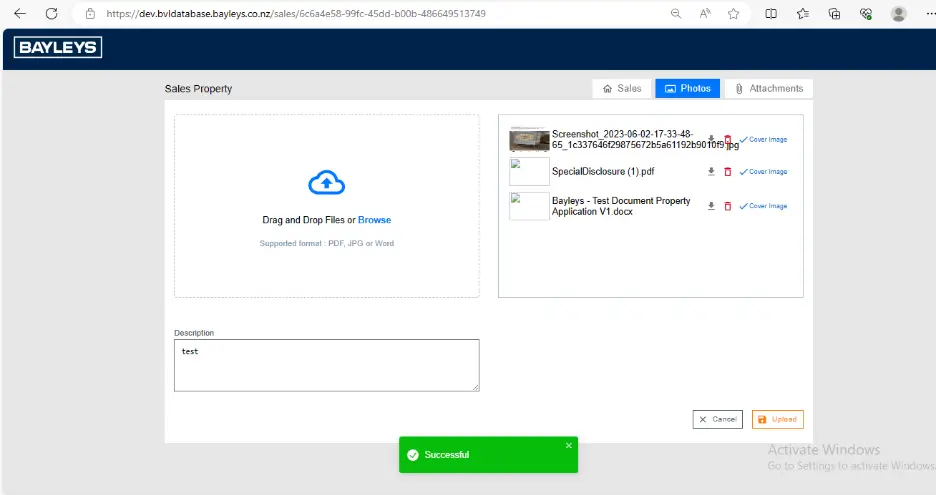
- Photo and document attachment — upload, download, and delete for both sales and rental records; stored in S3
- Sales and rental evidence report — combined report generation
- AWS deployment — Lambda, Aurora, Amplify, API Gateway, WAF, S3, KMS, Secrets Manager, CloudWatch
Phase C — Additional Features
- Word and Excel export of property evidence reports
- Google Maps radius search — restrict property search to X km radius of a searched NZ address
- Audit logs — logging of all data download and export events
- Email report delivery — send evidence reports via SNS/SQS email integration
- Advanced search enhancements — comma formatting on numeric fields, improved address suburb search
Phase D — Data Migration & Production
- Full data migration from Microsoft Access database to Aurora PostgreSQL
- UAT, bug fixing (5% effort allocation), production deployment
- Documentation and handover
- 1-month hypercare support post go-live
Implementation
Serverless Architecture
The backend was built entirely on AWS Lambda using C#, invoked via Amazon API Gateway. This eliminated server management entirely — Lambda scales automatically to handle any volume of concurrent requests, and the consumption-based pricing model means Bayleys pays only for actual usage. At 50,000 Lambda invocations per month, the Lambda cost is effectively zero under AWS’s free tier thresholds.
Authentication — Azure AD + AWS Cognito
Bayleys users authenticate using their existing Bayleys corporate Azure AD credentials. AWS Cognito is configured with Azure AD as the federated identity provider — users click ‘Sign in with Bayleys account’, are redirected to Azure AD for authentication, and returned to the CVE app with a JWT token. Admin role assignment is handled via Azure AD group membership, surfaced in the JWT claim and enforced on every Lambda endpoint.
Property Search & Google Maps Integration
The property search module allows Bayleys valuers to search commercial sales and rental evidence by property type, category, subcategory, location, date, price, building area, tenure, and keyword. NZ address lookup is powered by the Google Maps Places API with results restricted to New Zealand addresses only. The radius search feature allows valuers to find all comparable evidence within a defined kilometre radius of any NZ address — critical for commercial valuation work.
Data Model & Migration
The existing Microsoft Access database was analysed, mapped to a normalised PostgreSQL schema, and migrated to Amazon Aurora Serverless. Aurora’s serverless configuration means the database scales its capacity units automatically based on load — dropping to near-zero cost during idle periods and scaling up for peak search and reporting activity. The database is deployed in a private subnet with no public internet access; Lambda functions access it over the private network only.
Security Architecture
All API endpoints are protected by AWS WAF with AWS managed rule groups covering common web exploits, SQL injection, and bot traffic. AWS Shield Standard provides DDoS protection at the network layer. All sensitive configuration (database connection strings, API keys, third-party credentials) is stored in AWS Secrets Manager in encrypted format. Data at rest in Aurora and S3 is encrypted using AWS KMS. All data in transit is secured via HTTPS/TLS.
Technology & Architecture
| Frontend | React.js | AWS Amplify | responsive | Chrome · Edge · Firefox · Safari |
| Backend | C# (.NET) | AWS Lambda (serverless) | AWS API Gateway | event-driven architecture |
| Database | Amazon Aurora Serverless (PostgreSQL) | 99.99% SLA | auto-scaling | private subnet |
| Auth | AWS Cognito | Azure AD as identity provider | JWT tokens | role-based access (admin / user) |
| Storage | Amazon S3 | PDFs · photos · attachments | private endpoint access from Lambda | KMS encryption |
| Networking | AWS VPC | private subnets for Lambda & Aurora | AWS WAF on API Gateway | AWS Shield Standard |
| Security | AWS WAF (managed rule groups) | AWS Shield Standard | AWS KMS | AWS Secrets Manager | SSL/TLS |
| Notifications | Amazon SNS | Amazon SQS | email delivery for property reports |
| Monitoring | Amazon CloudWatch | AWS CloudTrail | alert & monitoring dashboards |
| DevOps | AWS CloudFormation (IaC) | CI/CD pipelines | Dev · Test · Prod environment parity |
| Integrations | Google Maps API (NZ address lookup · radius search) | Azure AD SSO | Word/Excel/PDF export |
| Region | Asia Pacific — Sydney | monthly AWS cost: USD $124.22 | 12-month total: USD $1,490.69 |
Architecture Overview
A high level architecture diagram as below
Challenges
Access Database Migration to Aurora PostgreSQL
The legacy Microsoft Access database had an unstructured schema built over many years of ad hoc property data entry. Peritos mapped the full Access data model to a normalised PostgreSQL schema before migration, handled data type conversions, and validated migrated data record-by-record against the source before go-live.
Azure AD Federated Identity via AWS Cognito
Integrating Bayleys’ corporate Azure AD as the identity provider for an AWS-native application required careful configuration of OIDC federation in Cognito, JWT claim mapping for admin role detection, and testing across all authentication edge cases — including token expiry, re-authentication, and admin privilege escalation via group membership.
NZ-Only Address Restriction
Google Maps Places API returns global results by default. Enforcing NZ-only address lookup required both frontend component configuration (restricting the Places autocomplete to NZ) and backend validation on address submission — ensuring no non-NZ property records could be created through direct API calls.
Complex Valuation Analysis Fields
The sales evidence entry form includes specialist commercial valuation fields — Building Rate ($/psm), Equivalent Market Yield (%), IRR (%), WALT (years to 2dp), Vacancy (%) — each with specific unit formatting requirements and conditional display rules (e.g. subcategory only active for Commercial Office and Commercial Retail). Getting the field logic right required close collaboration with Bayleys valuers through multiple UAT cycles.
Under Two Months End-to-End
Delivering a fully serverless custom application — including data migration, three AWS environments, CI/CD pipelines, Azure AD integration, Google Maps integration, and report export — in under two months required strict parallel workstreaming across infrastructure setup, backend development, frontend development, and data migration, with daily sprint cycles and rapid UAT feedback turnarounds.
Key Benefits
- Fully serverless — zero server management, automatic scaling, consumption-based pricing at USD $124/month for a full commercial property evidence platform
- Single sign-on — Bayleys staff use their existing corporate Azure AD credentials with no new password or account required
- Cloud-native from day one — built following the AWS Well Architected Framework across all 5 pillars, with IaC (CloudFormation) and CI/CD pipelines ensuring repeatable, reliable deployments
- Access database retired — legacy desktop-only, single-user Access database replaced by a scalable multi-user cloud application accessible from any device and browser
- Google Maps radius search — valuers can find comparable evidence within any km radius of any NZ address, directly inside the application without external tools
- 99.99% database SLA — Aurora Serverless PostgreSQL delivers enterprise-grade availability with automatic failover and no database administration overhead
- Complete audit trail — CloudWatch logging, CloudTrail, and application-level audit logs capture all data access and export activity
Post-Launch Support
Hypercare Period
A 1-month free hypercare period was included from the go-live date. Peritos monitored CloudWatch metrics, resolved all post-launch issues, and provided guidance on Aurora capacity tuning and Lambda concurrency configuration. All Phase B UAT test scenarios (45+ test cases across sales entry, rental entry, and search) were confirmed passed before the hypercare period commenced, with only 3 bugs raised and resolved during testing.
A support contract proposal was prepared for ongoing AMC support following the hypercare period, covering Lambda, Aurora, Amplify, and application-level support.
About the Client
| Client | Ultimate Property |
| Location | New Zealand |
| Industry | Property Management | Residential sales & rental |
| Portfolio | Multiple buildings | Sales and rental management across NZ |
| Target market | English and Chinese-speaking buyers and tenants |
| Engagement | Website development & Azure hosting | Jan – Mar 2023 |
| Delivered by | Peritos Solutions |
Ultimate Property is a New Zealand-based property management company managing multiple buildings across residential sales and rental markets. Their client base spans English and Chinese-speaking buyers and tenants, requiring a bilingual web presence with seamless agent contact and social media integration.
Project Background
Ultimate Property needed a professional, bilingual property portal to showcase their building and apartment portfolio to both English and Chinese-speaking audiences across New Zealand. Their existing web presence lacked structured building and apartment templates, had no Facebook integration, and offered no bilingual support for the significant Mandarin and Cantonese-speaking segment of their client base.
Peritos Solutions was engaged to customise WordPress on Azure, build purpose-designed templates for buildings and individual apartments, integrate with Facebook for automated social posting and lead capture, and deliver a fully bilingual site — all within a three-month timeline from January to March 2023.
Project Timelines
| Phase | Period | Key Activities | Status |
| Phase A | Jan 2023 | Requirement gathering, FB/TradeMe access, design sign-off, data format preparation, Azure environment setup | Done |
| Phase B | Jan – Feb 2023 | WordPress upgrade to v5.7, building & apartment templates, bilingual support (EN/ZH), QR codes, 10 contact forms, property search page, Facebook auto-post integration | Done |
| Phase C | Feb – Mar 2023 | Facebook lead capture form (email instead of chat), shared FB posting ID, unit testing, bug fixing | Done |
| Handover | Mar 2023 | Documentation, CMS training, agent management guide, Azure hosting handover, 2-week post-launch support | Done |
Results & Impact
Observability & Visibility
Assessment Report
Before any development work commenced, Peritos conducted a structured discovery phase:
- Risk & Gap Analysis — reviewed the existing WordPress installation, identified version gaps (upgraded to 5.7), Facebook integration requirements, and bilingual content needs before starting build
- Customised Assessment Report — documented the full scope across Phase A, B, and C with task-level status tracking, re-estimate triggers, and a clear development roadmap signed off by the client
- Azure environment validated — dev instance (ultimate-property-dev.azurewebsites.net) provisioned and confirmed before any production changes were made
Cloud Formation
Azure Hosting & Integration
The full Azure-hosted stack was provisioned and configured as part of the engagement:
- Azure App Service used as the WordPress hosting layer — dev and production environments maintained separately throughout the project
- Facebook integration via Blog2Social — posts published on WordPress automatically cross-post to the Ultimate Property Facebook page with image and link
- Facebook lead capture form updated — previously chat-based, now routes leads directly to email for agent follow-up
- Azure App Service Backup configured — pre-upgrade snapshot taken before WordPress update, with ongoing backup policy in place
Scope & Requirements
Phase A — Requirements & Setup
- Requirement gathering, Facebook page access, TradeMe account access, and user list collection
- Website designs reviewed and integration scenarios mapped
- All building and apartment data collected in structured format for backend loading
- Azure dev environment provisioned — ultimate-property-dev.azurewebsites.net
Phase B — Website Customisation
- WordPress upgraded and backed up to v5.7 (latest stable)
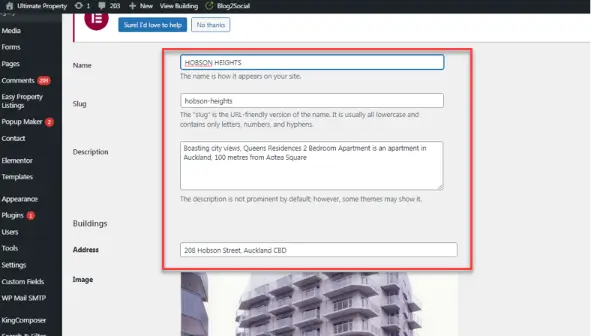
- New building page template — building name, description, images, address, and agent widget
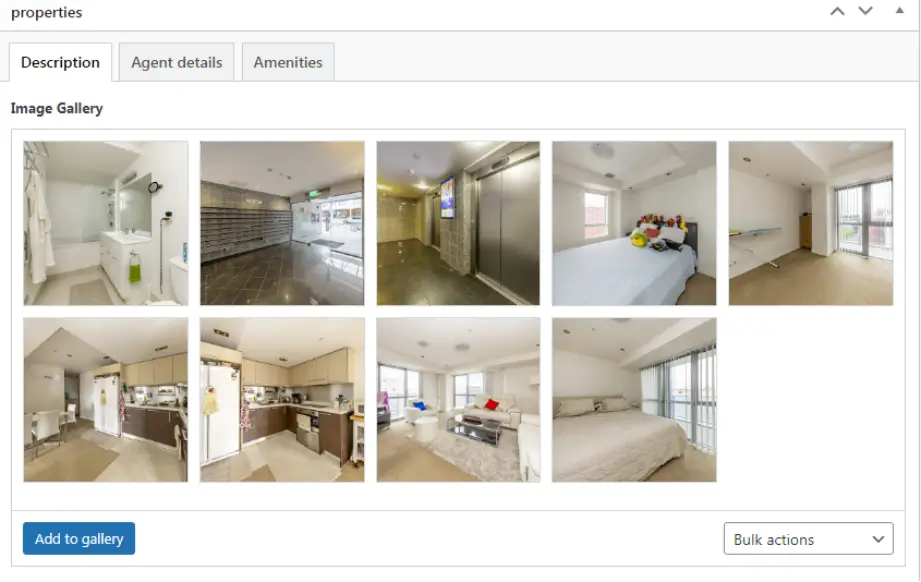
- New apartment page template — price, duration, date of availability, number of rooms, agent details, image gallery, with Mandarin/Cantonese language option
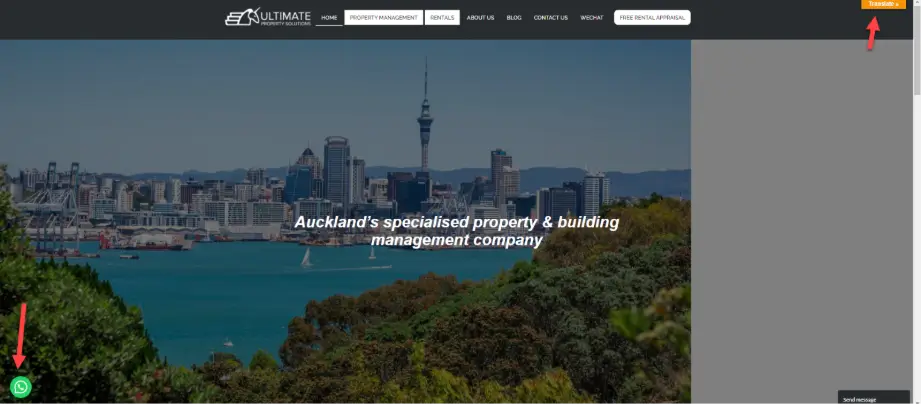
- Bilingual support — Google Translate plugin activated for English and Chinese (Mandarin & Cantonese)
- QR code added to site footer — standard plugin implementation
- 10 building-specific contact forms — each form emails agent, user, and admin on submission
- Property search page — 1 search result listing view with building tag filtering
- Facebook auto-post integration via Blog2Social — post with image and link auto-published on WordPress content publish
- Agent management — agent details manageable via WordPress Users section with editor role
Phase C — Facebook Changes
- Facebook lead capture form updated — chat replaced with email routing for lead delivery
- Shared Facebook posting ID configured — allows posting from a common account
- Unit testing (15%) and bug fixing included
Additional Scope Delivered
- Property management and rental menu options highlighted in navigation
- Contact Us page section updated
- Facebook page created and content updated
- WhatsApp message icon added to site for direct mobile contact
- Building write-ups authored and apartment content written based on available information
Implementation
Azure Hosting Setup
The WordPress site was hosted on Microsoft Azure App Service with a dedicated dev environment for all testing and staging. A full backup was taken before the WordPress upgrade was applied. The dev URL (ultimate-property-dev.azurewebsites.net) was used for all client UAT before changes were pushed to production.
Building & Apartment Templates
Custom WordPress page templates were built for buildings and individual apartments. The building template includes name, description, image gallery, address, and a linked agent widget. The apartment template captures price, availability date, number of rooms, images, and agent assignment — all manageable from the WordPress dashboard without developer involvement. Properties are tagged to buildings using WordPress taxonomy, allowing the search page to filter by building.
Bilingual Implementation
Google Translate plugin was integrated and configured with both Mandarin and Cantonese as target languages alongside English. Individual apartment pages were also built with a native Mandarin/Cantonese content option for listings specifically targeting Chinese-speaking buyers and tenants, ensuring accurate property descriptions rather than machine-translated text.
Facebook & Social Integration
Blog2Social plugin was configured to automatically publish a post to the Ultimate Property Facebook page whenever new content is published on WordPress — including the property image and a direct link to the listing. The Facebook lead capture form was updated to route enquiries to email (previously delivered to chat only), ensuring agents receive leads in their inbox immediately. A shared posting ID was also configured to allow the wider agent team to post from a common Facebook identity.
Contact Forms & Lead Routing
Ten individual contact forms were built — one per building — each configured to send the submission simultaneously to the relevant agent, the enquiring user (confirmation), and the admin. Contact Form 7 was used as the form plugin, with SMTP email routing configured and tested end-to-end for all 10 building forms.
Application screenshots—WordPress admin dashboard, building template, apartment listing, bilingual toggle, and Facebook post examples here.
 Technology & Architecture
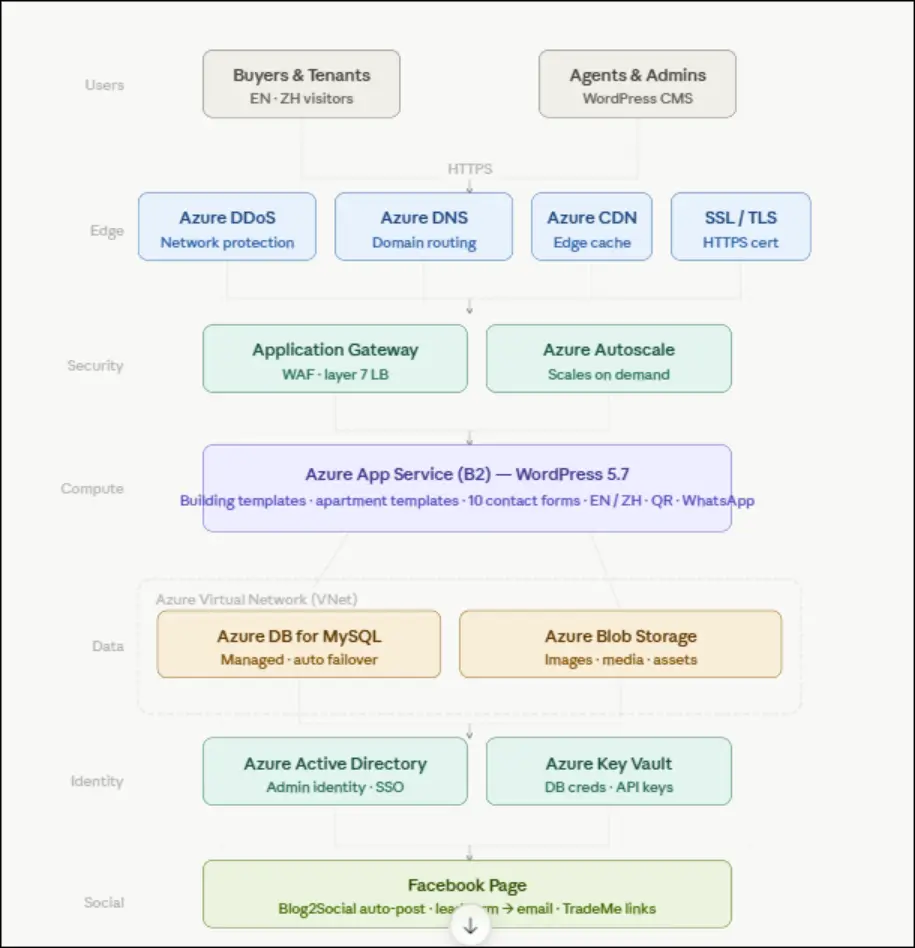
| Compute | Azure App Service (B2 tier) | App Service Plan | Azure Autoscale | Dev & Prod environments |
| Database | Azure Database for MySQL | managed | automated backups | high availability |
| Storage & CDN | Azure Blob Storage | property images & media | Azure CDN | global content delivery for NZ & international |
| Networking | Azure Virtual Network (VNet) | private app-to-DB connectivity | Azure DNS | Application Gateway + WAF |
| Security | Azure Active Directory (AAD) | Azure Key Vault (credentials & API keys) | Azure DDoS Protection | SSL/TLS |
| Monitoring | Azure Monitor | Azure Application Insights | Azure Alerts | email & SMS notifications on threshold breach |
| Backup & DR | Azure Backup | daily automated snapshots | configurable retention | Azure Site Recovery (cross-region failover) |
| CMS | WordPress 5.7 | custom building & apartment templates | HTML editor integration |
| Plugins | Blog2Social (FB auto-post) | Google Translate (EN/ZH) | QR Code | Contact Form 7 | Property listing plugin |
| Integrations | Facebook Pages (auto-post + lead capture) | TradeMe listings | WhatsApp message icon |
| Languages | English | Chinese Mandarin & Cantonese | Google Translate plugin |
| Forms | 10 building-specific contact forms | email routing to agent, user & admin on submission |
| Testing | 7 test scenarios | 100% pass rate | Azure dev environment for all UAT |
Architecture Overview
Here is a high level Architecture diagram
Challenges
Bilingual Content — Machine Translation vs. Native Copy
Google Translate provides automated translation which is sufficient for navigation and general UI text, but property descriptions for Chinese-speaking audiences required accurate, culturally appropriate copy. Peritos built apartment templates with a native Mandarin/Cantonese content field separate from the English version, allowing Ultimate Property to publish accurate translated descriptions where needed rather than relying on machine translation alone.
10 Building Forms with Individual Routing
Each of the 10 buildings had different agent assignments and admin notification requirements. Building individual forms with distinct email routing logic — while keeping the WordPress admin experience simple enough for non-technical staff — required a systematic approach: a templated form structure in Contact Form 7 with per-form routing configuration, tested end-to-end for each building before handover.
Facebook Integration Reliability
Blog2Social’s automatic Facebook posting required careful configuration of posting permissions, shared account ID setup, and post format (image + link) to match Facebook’s current API requirements. Peritos tested the full post-to-Facebook flow in the dev environment before enabling it on production, ensuring the first live property post published correctly.
Data Loading at Scale
Loading building and apartment data across multiple properties required all content to be provided in a structured format before development. Peritos defined the data template upfront during Phase A and worked with Ultimate Property to prepare building write-ups and apartment details — preventing rework during the build phase and keeping the project on its three-month timeline.
Key Benefits
- Bilingual reach — English and Chinese (Mandarin/Cantonese) support opens the site to NZ’s significant Chinese-speaking property market without requiring separate websites
- Automated social presence — every new property listing automatically posts to Facebook with image and link, keeping the social channel active with zero manual effort
- Structured lead capture — 10 building-specific forms route every enquiry directly to the right agent instantly, reducing response time and missed leads
- Self-manageable CMS — building and apartment templates are designed so Ultimate Property’s team can add new listings, update prices, and publish content independently
- Azure-hosted reliability — Azure App Service provides a managed, scalable hosting environment with built-in backup and dev/prod separation
- 3-month delivery — full design, customisation, integration, bilingual setup, and Azure hosting delivered end-to-end in one quarter
Post-Launch Support
Handover & Support Period
A 2-week post-launch support period was included. Peritos delivered a full handover pack covering: how to add and manage buildings and apartments, how to manage agents and user roles, how to use Blog2Social for Facebook posting, and how to manage the Azure App Service environment. All 7 test scenarios were confirmed passed before the support period commenced, with zero open bugs at handover.
About Client
DEEPIQ simplifies industrial analytics and offers the only self-service application for end-to-end (Data + AI) OPs for the industrial world. With this app, your SMEs can digitize their expertise, and your data teams can build and deploy robust analytic pipelines.
- https://deepiq.com/
- Location: Have Offices Globally in USA, India, Canada
Project Background
DeepIQ required a proof-of-concept integration layer to extract Vendor master data and Work Order information from their SAP system and expose it to external applications. The goal was to evaluate viable integration patterns — SOAP, REST, BAPI/RFC — and deliver a working, reusable service layer that could be extended to production.
The project was executed by Peritos Solutions under a phased delivery model, beginning with an assessment and requirement-gathering sprint before moving into build and testing phases.
Scope & Requirements
In Scope
- Integration of Vendor master data (list and detail) from SAP
- Work Order data retrieval filtered by vendor number and date range
- Custom BAPI development with up to 10 input fields and up to 50 output fields
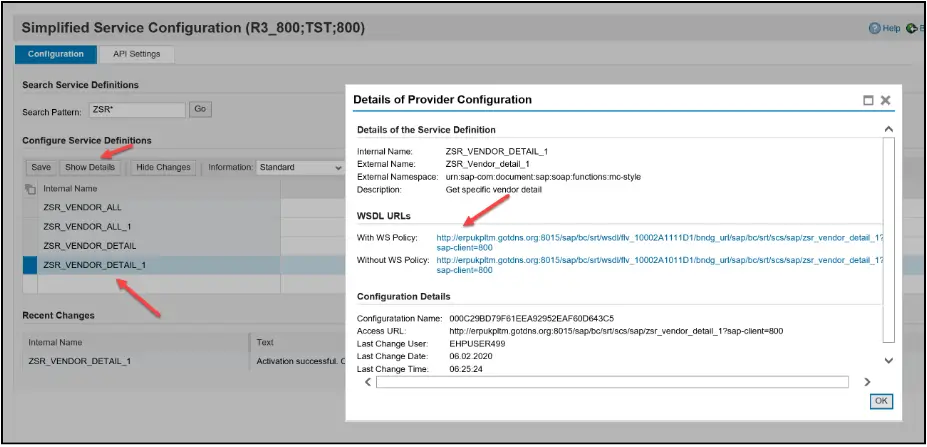
- SOAP web service (WSDL) exposure via SAP transaction SE37 / simplified web service
- REST-based service exposure via SAP SICF (z_ven_wrk_ords)
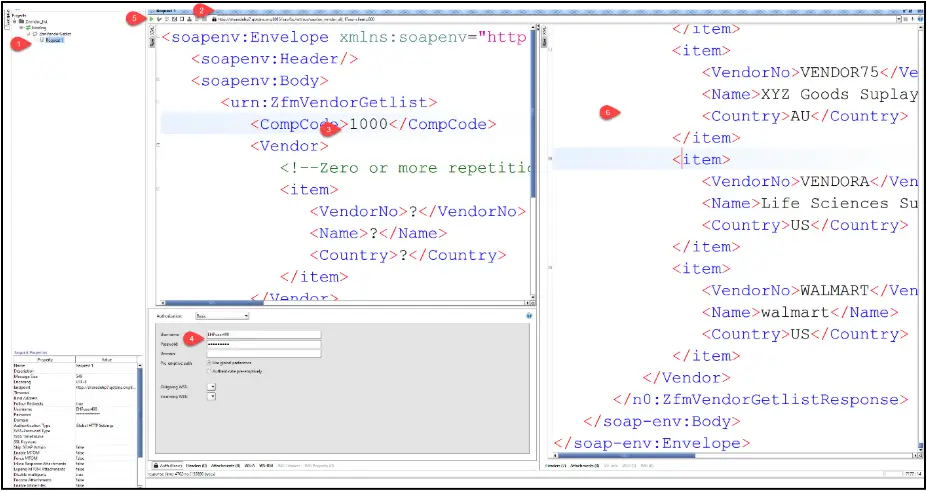
- Unit testing via SOAP UI and Postman
- JSON output serialisation using /ui2/cl_json
- 1 week of post-delivery hypercare support
Out of Scope
- Production deployment and middleware (Informatica/MuleSoft) configuration
- Customer master beyond the agreed POC scope
Project Timelines
| Phase | Duration | Key Deliverables | Status |
| Assessment | < 2 wks | Requirement gathering, SAP system access, Risk & Gap Analysis, Customised Assessment Report | Done |
| Phase B | 2–3 wks | Custom BAPI design, ABAP OOP coding, WSDL web service exposure, SOAP UI unit testing | Done |
| Phase C | 2–3 wks | REST-based SICF service (z_ven_wrk_ords), JSON output, Postman testing, 1-week support | Done |
| Hypercare | 1 wk | Post-go-live support, bug fixing, documentation handover | Done |
Results & Impact
Observability & Visibility
Assessment Report
A comprehensive assessment was completed in under two weeks. This included:
- Risk & Gap Analysis — identifying SAP version constraints, authentication settings, and BAPI structural gaps
- Customised Assessment Report — delivered to the client with architecture recommendations and approach sign-off
- Integration approach validated against SAP R/3 / S/4HANA constraints before any code was written
Cloud Formation
Integration — Delivered in < 2 Weeks per Phase
Each integration phase was scoped, built, and tested in a rapid sprint cadence:
- Phase B — SOAP/WSDL: Custom BAPI (Z_VEN_WRK_ORDS) created with ABAP OOP, exposed as a simplified web service. Vendor list and detail endpoints validated via SOAP UI.
- Phase C — REST: Wrapper class implementing IF_HTTP_EXTENSION registered as a SICF service. JSON responses verified via Postman for vendor list, vendor detail, and work-order queries.
Key Outcome Metrics
| ✔ Observability & Visibility
Full assessment report delivered with risk & gap analysis within 2 weeks. |
☁ Cloud-Ready Integration
REST & SOAP web services exposed from SAP — ready for cloud consumption. |
⚡ Rapid Time-to-Value
Custom BAPI developed & tested end-to-end in under 8 weeks. |
Implementation
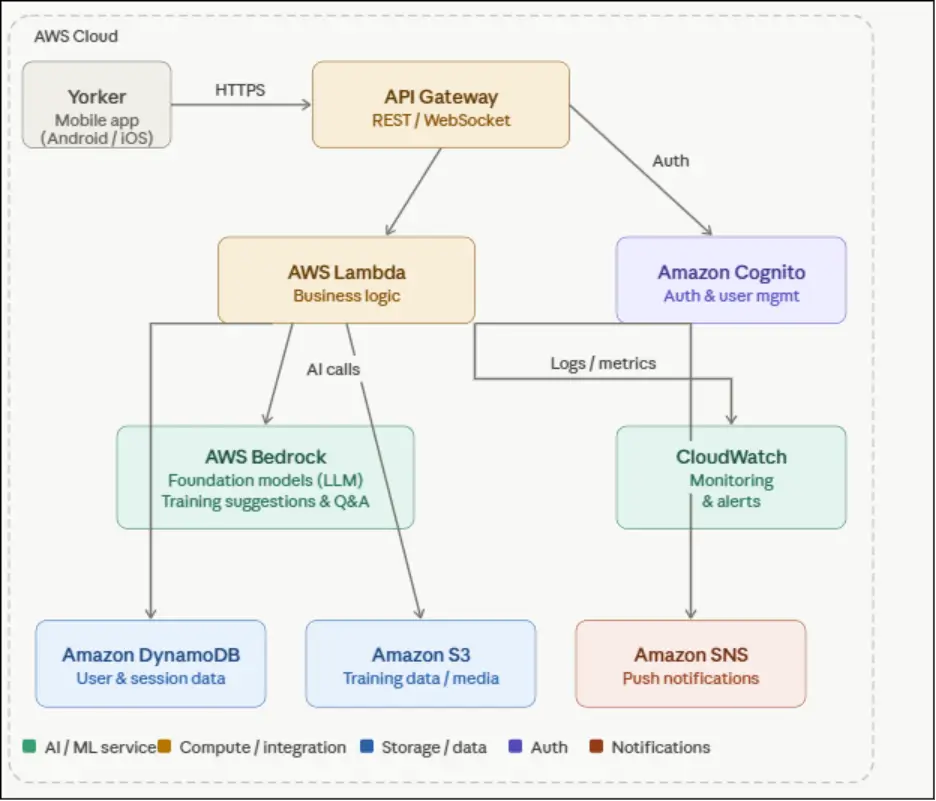
Architecture Overview
Below is a high level Architecture Diagram overview
Technology & Architecture
| SAP Core | SAP R/3 · S/4HANA | ABAP OOP | BAPI / RFC |
| Integration | SOAP Web Services (WSDL) | REST / HTTP (SICF) | JSON |
| Tooling | SOAP UI | Postman | Informatica ETL |
| Data Scope | Vendor Master | Customer Master | Work Orders |
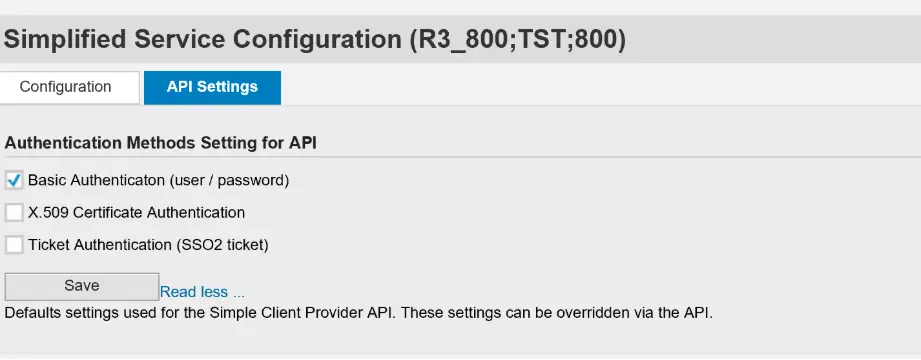
| Auth | HTTP Basic Auth | Service User credentials |
| Output Format | JSON (serialised via /ui2/cl_json) | XML / WSDL |
Challenges
Authentication Configuration
SAP’s web service authentication settings required careful tuning. Multiple configurations were tested before identifying the correct combination of HTTP handler and service user credentials that allowed external SOAP calls to succeed.
Date Filter Logic
Initial work-order retrieval returned data outside the requested date range. The ABAP selection logic was corrected to enforce strict date boundary matching (GSTRP GE i_start AND GSTRP LE i_end), and output dates were reformatted to DD/MM/YYYY.
Vendor Number Formatting
Vendor numbers required CONVERSION_EXIT_ALPHA_OUTPUT normalisation to strip leading zeros and match expected formats in the consuming application.
Compressed Timeline
All three phases were delivered in parallel with the client’s internal scheduling constraints, requiring iterative development with 2–3 day feedback cycles and daily stand-ups.
Key Benefits
- Reusable service layer — both SOAP and REST endpoints can be extended to additional SAP objects without re-architecture
- Zero middleware dependency — services are natively exposed from SAP, removing Informatica licensing requirements for the POC
- Rapid time-to-value — working, tested integration delivered in under 8 weeks from initial engagement
- Comprehensive documentation — WSDL definitions, ABAP code bundle, unit test evidence, and architecture notes handed over at project close
- Clean handover — 1-week hypercare period with all bugs resolved (100% test pass rate)
Post-Go-Live Support
Hypercare Period
A dedicated one-week hypercare period was included post-delivery. During this period DeepIQ resolved all outstanding defects, provided guidance on SAP navigation, and completed final documentation. All six functional test scenarios and both raised bugs were closed with a Pass status before handover.
Application screenshots are included below as placeholders — replace with actual Postman / SOAP UI test captures.
About Client
Electric Kiwi is an autonomous online New Zealand electricity retailer. Established in 2014, Electric Kiwi uses cloud computing and intelligent meters to service customers nationwide in major urban areas. Its services depend on the presence of the smart meters in the customer’s home. For the client, we did the POC for integrating AWS Support Services with Datadog’s CloudFormation template.
- http://www.electrickiwi.co.nz/
- Location: New Zealand
Project Background
The case study of the project provides a synopsis of how we did the POC for the client for integrating AWS Support Services, an AWS account with Datadog employing Datadog’s CloudFormation template. Creating an IAM role and associated policy enables Datadog’s AWS account to make API calls for collecting or pushing data into your AWS account. Using the CloudFormation template supplies all the tools required to send this data to your Datadog account, and Datadog helps the CloudFormation template to provide the latest functionality. The template even deploys the Datadog Forwarder Lambda operation for sending logs to Datadog.
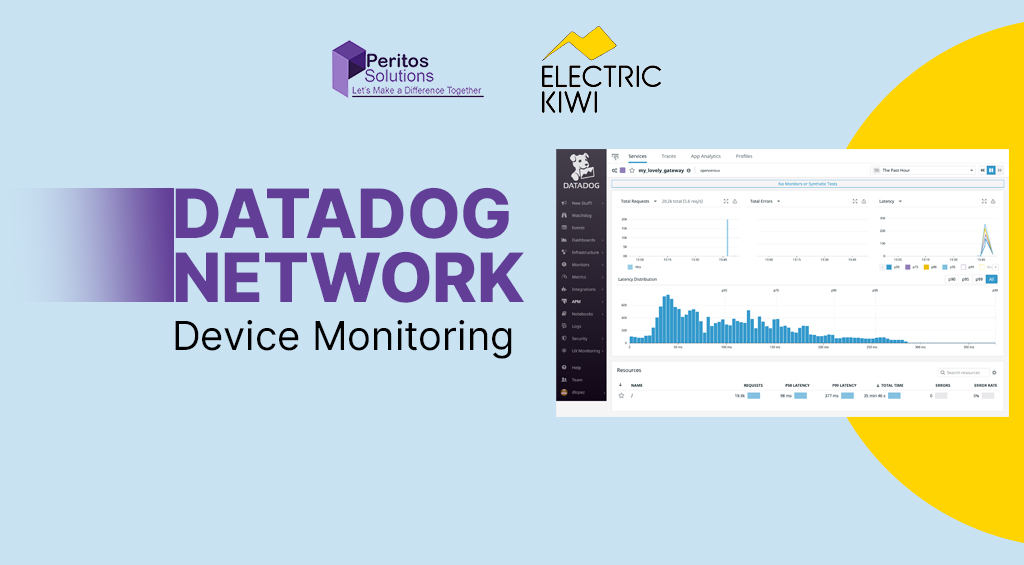
After setting the initial connection, enable the individual AWS service integrations appropriate to your AWS domain. With a single click, Datadog provisions the required resources in your AWS account and starts analyzing the metrics and events for the services you use. For general AWS services you are using, Datadog needs out-of-the-box dashboards providing prompt and customizable visibility. The project background demonstrates setting up the integration and establishing the Datadog Agent on an Amazon Linux EC2 instance and feeds a broad outline of the integration’s capabilities. Visit the Enable integrations for individual AWS service factions for a list of the general sub-integrations.
This procedure can be repeated for multiple AWS accounts as required, or you can also use the API, AWS CLI, or Terraform to set up various accounts simultaneously. For more details, read the Datadog-Amazon CloudFormation guide.
Scope & Requirement
The scope & requirements involved the following:
- Datadog integration with AWS support services to measure and accomplish observability matrix
- Identified costing
- Updated pricing with partner discount as applicable
- Shortlisted services for which we did POC
- EC2, database Monitor Requirement, Steps, and Dashboard View
- Along with pricing and cost for using Datadog; for monitoring and analytical purpose
Implementation
Technology and Architecture
Technology/Services used
We used Datadog integration with AWS services to masure and do observability matrix and helped them to setup below
- Cloud: AWS
- Shortlisted services for which we did POC
- Organization setup: Control tower
- Policies setup: Created AWS service control policies
- Templates created for using common AWS services
Security & Compliance:
- Tagging Policies
- Azure config for compliance checks
- NIST compliance
- Guardrails
- Security Hub
Backup and Recovery
- AWS Backup provided a simple, secure, cost-effective, and cloud-based backup solution which was already implemented for the client
Network Architecture
- Site to Site VPN Architecture using Transit Gateway
- Distributed Azure Network Firewall
- Monitoring with Cloud Watch and VPC flow logs.
Cost Optimization
- Alerts and notifications are configured in the AWS cost
- Identified Costing
- Updated pricing with partner discount as applicable
Code Management, Deployment
- Cloudformation scripts for creating stacksets and scripts for generating AWS services was handed over to the client
Challenges
- Access was not provided to the actual environment and setting up
- Complex environment setup and monitoring for production cost was only possible to evaluate if we have got the access for the actual environment from the client
Support
- 1 month of extended support
- A template for Cloud formation stack to create more AWS resources using the available stacks
- Screen-sharing sessions with a demo of how the services and new workloads can be deployed.
About Client
Managing AWS Environment
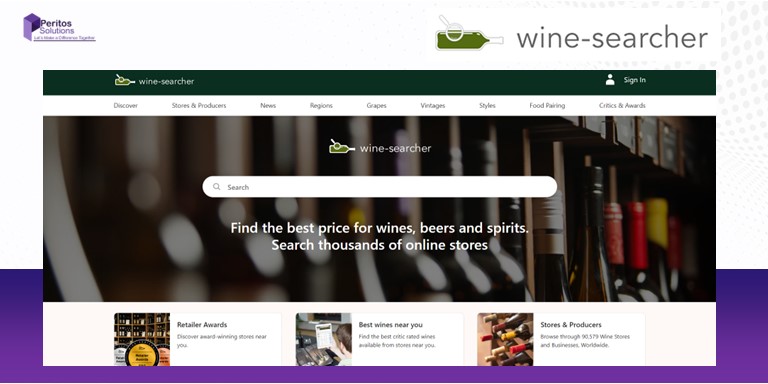
Wine-Searcher is a web search engine that helps find the price and availability of any wine, whiskey, spirit, or beer worldwide. It has been in operation since 1999 and has offices in New Zealand and the UK. They provide an easy-to-use search engine, price comparison tools, an extensive database of wines and spirits, an encyclopedia, and news pages that aim to provide all “wine-finding” needs.
- https://www.wine-searcher.com/
- Location: New Zealand & UK
Project Background
As part of their plan to launch a full suite of digital products, Wine-Searcher chose AWS as their cloud environment. Strategic resource allocation and cost optimization are critical to ensure a cost-effective operation. Peritos helped as the reliable AWS partner on AWS Cost Explorer and AWS Budgets, like valuable tools for implementing ongoing discounted billing. Furthermore, leveraging reserved instances and spot instances and optimizing usage based on peak hours and demand patterns can result in significant cost savings. Experts from the Peritos team helped regularly monitor and fine-tune the AWS environment based on Winesearcher’s needs, allowing for continuous optimization while adhering to budgetary constraints and maintaining the required scalability and performance for their operations.
Scope & Requirement for Managing AWS Environment
In the 1st Phase of the AWS Environment Setup, implementation was discussed as follows:
- Manage Billing
- Value added services
- Handling Complex environments
- Multiple AWS invoices
- Cost Optimization
- Cloud security optimization
Implementation
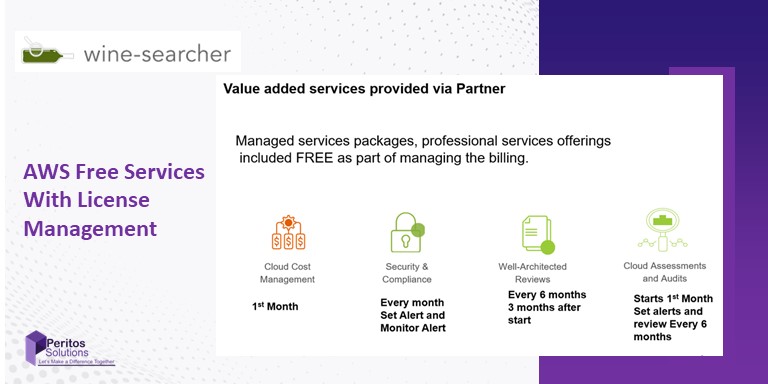
Technology and Architecture of Managing AWS Environment
Furthermore, Read on the key components that defined the Architecture for managing the AWS Environment Setup for Wine-Searcher
Technology/ Services used
We used AWS services and helped them to setup below
- Cloud: AWS
- Organization setup: Control tower
- AWS SSO for authentication using existing AzureAD credentials
- Policies setup: Created AWS service control policies
- Templates created for using common AWS services
Security & Compliance:
- Tagging Policies
- AWS config for compliance checks
- NIST compliance
- Guardrails
- Security Hub
Network Architecture
- Site to Site VPN Architecture using Transit Gateway
- Distributed AWS Network Firewall
- Monitoring with Cloud Watch and VPC flow logs.
Backup and Recovery
- Cloud systems and components used followed AWS’s well-architected framework, and the resources were all Multi-zone availability with uptime of 99.99% or more.
Cost Optimization
- Alerts and notifications are configured in the AWS cost
Code Management, Deployment
Cloudformation scripts for creating stack sets and scripts for generating AWS services were handed over to the client
Challenges in Implementing Managing AWS Environment
- Collate all accounts together
- Understand and agree on how the account would be managed under the distribution model
Support
- One month of extended support
- A template for Cloud formation stack to create more AWS resources using the available stacks
- Screen-sharing sessions with demos of how the services and new workloads can be deployed.
Next Phase
We are now looking at the next phase of the project, which involves:
- Implementing a control tower for the client.
About Client
Pioneer Group has been in the education field past 1996. Pioneer Public School might be a new name in the education industry but people are well-versed with Pioneer Institute of Professional Studies and Pioneer Convent. The school focuses on providing a blend of education and culture to its students.
- Offers children basic and advance facilities while imparting easy education
- Teaches children through audio-visual modules
- A staff of trained teaches that focuses on giving an all-round development to the students
http://www.pioneerpublicschool.com/
Location: Indore, Madhya Pradesh, India
Project Background- Online Attendance Management
Pioneer Public School got together with Peritos to discuss the struggles of maintaining attendance records in online classes during lockdown. Peritos instantly suggested the school attendance tracking app as it is easy to use and all the information is just a click away. Also, the school attendance tracking software will give the liberty of making the entire process of attendance, class schedule and timings transparent for students, teachers and even parents. This was implemented first for Pioneer Institute Of Professional Studies which is an organization in the same group after which a similar version was implemented .
Scope & Requirement
IN the 1st Phase of online attendance management, it was discussed to have the following-
Teacher Mode:
- Design a school attendance tracking app where a teacher can view the list of children assigned to them.
- Children will be attending multiple lectures in a day.
- The teacher needs to check-in and out after each of the lectures.
- Ability to export attendance for each class or student
Student Mode/ Parent Mode
- Student / Parent should be able to see the online attendance management system
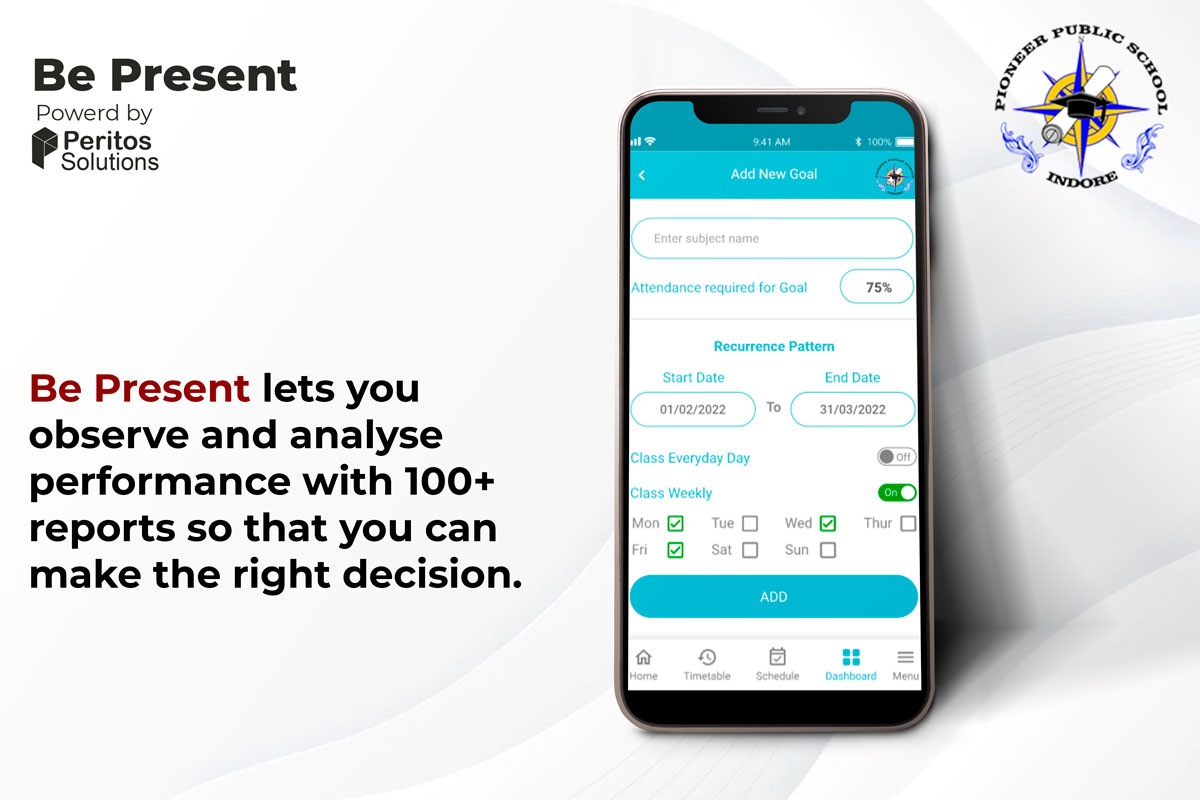
- Check the Goal vs Achieved attendance criteria
- Backend would be done via mass upload at the Go live date by the admin to upload all Student, Teachers and Subject schedule with the timings.
Implementation
Technology and Architecture
Technology
- The web app was deployed with the below technological component
- Backend Code: .NET Core, C#, Node.js
- Mobile App code: React Native
- Web App code: ReactJS
- Database: SQL Server, MongoDB
- Cloud: Microsoft Azure
Integrations
- Migration from an on-premise database to Online Student, Teacher, Subject database
- Single Sign-on using Auth0
- Sendgrid
Security:
- Data Encryption
- Multi-Factor Authentication for Admin, Teacher, and students when logging in
- All API endpoints are tokenized
Backup and Recovery
Cloud systems and components being used are secure and with 99.99% SLA. We have added HA/DR mechanism to create a replica of the services
Scalability
Application is designed to scale up to 10X times the average load received on the 1st 6 months of its usage and all cloud resources are configured for autoscaling based on the load
Cost Optimization
Alerts and notifications are configured to notify if the budget is being exceeded. Peritos being a cloud partner is managing the environment for the client by keeping a close watch on the cost and finding ways to optimize the same
Code Management, Deployment
- Code for the app is handed over to the client through Microsoft App Center.
- CI/CD is implemented to add automatically build and deploy any code changes
Features
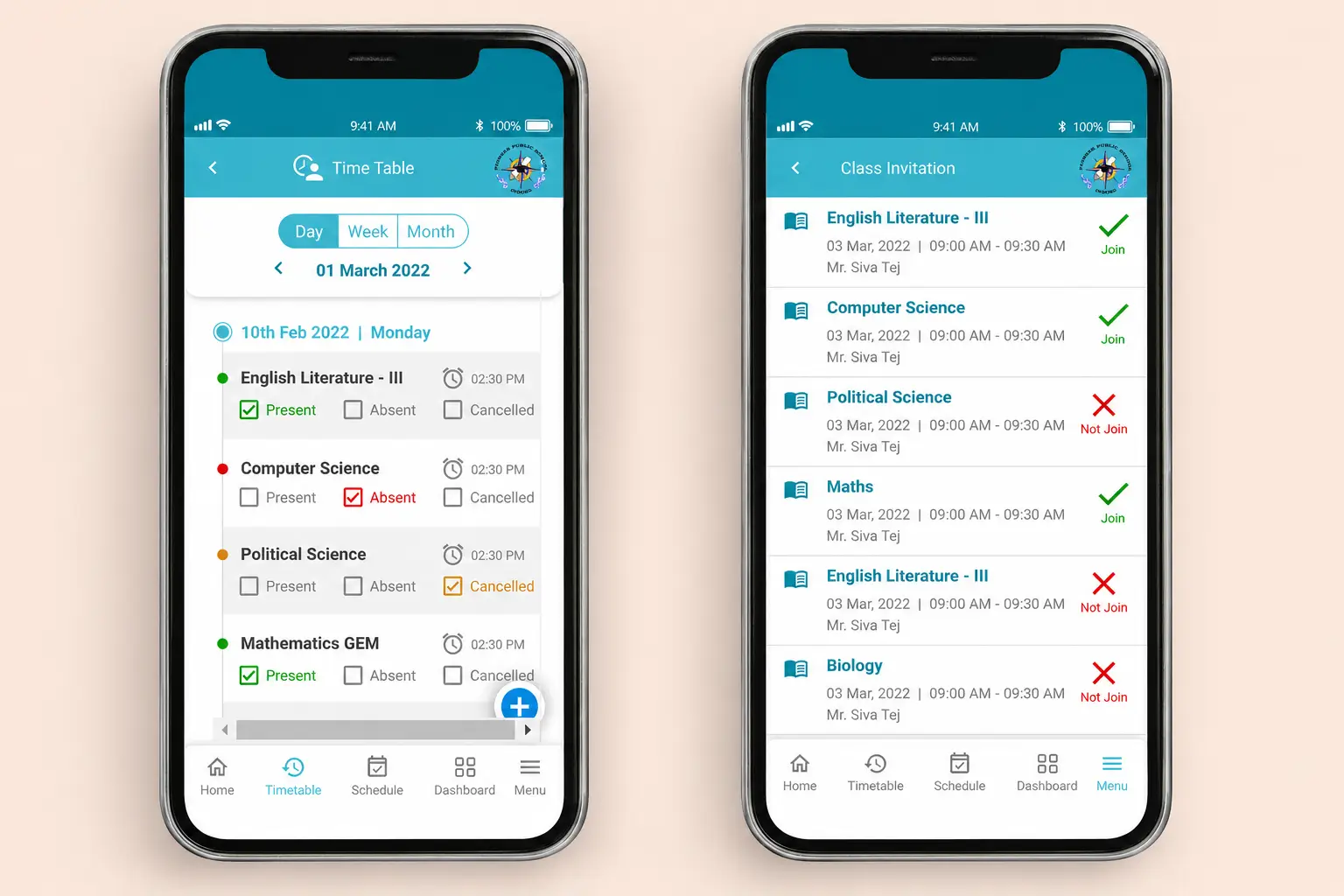
- Students are able to see the list of subjects and timetable at the click of mouse
- Teachers are able to see the list of subjects , classes and student’s attendance and mark daily attendance
- Students are able to view the attendance % and the minimum attendance needed vs achieved
- On the go attendance marking and calculations are updated
- Holidays and classes cancelled are incorporated in the minimum attendance calculations
- Quick setup, Dashboard view
Challenges
- Getting the huge amount of data to incorporate and add to the online database. We took an online database migration tool and added AI ML logic to ensure we could do a quick sanity testing with some test cases to be sure the app works as expected.
- Since the students and teachers were both used to the manual way of working for managing the attendance it became a huge effort to train the entire lot.
- The app we developed was simple enough to use so just with a 15 min basic tutorial and training the teacher and super users we were able to achieve this within an 8 working today time frame.
Support
As part of the project implementation we provided 1 month of extended support. This includes any major / Minor bug fixes.
Next Phase
We are now looking at the next phase of the project which involves:
- Ongoing Support and adding new features every Quarter with minor bug fixes
- Web based module to have admin be able to mass Upload teacher, students rolled out for the backend staff
About Client
AWS Control Tower Setup
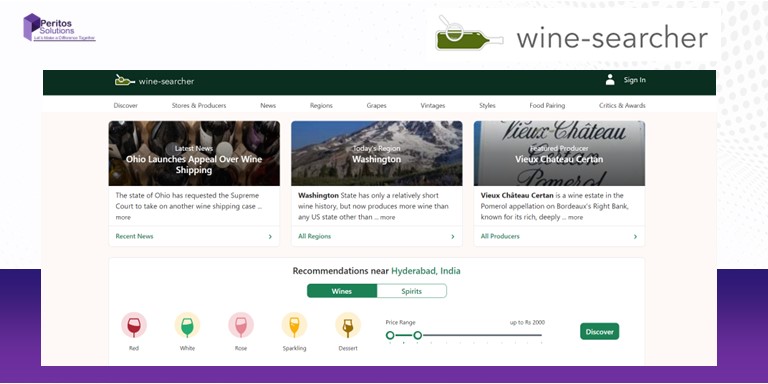
Wine-Searcher is a web search engine that helps find the price and availability of wine, whiskey, spirits, and beer worldwide.
It has been operating since 1999, with offices in New Zealand and the UK. The platform offers search tools, price comparison,
an extensive database, an encyclopedia, and news content to support all wine-finding needs.
- https://www.wine-searcher.com/
- Location: New Zealand & UK
Project Background
Peritos led the AWS Control Tower setup for Wine-Searcher, optimizing their cloud infrastructure.
The implementation streamlined governance, improved compliance, and enabled secure scalability.
Multiple accounts were consolidated and managed using AWS Organizations within Control Tower.
The environment was configured to meet specific business needs, ensuring efficient resource management
and cost control. With built-in automation and governance, Wine-Searcher gained a strong foundation
for future growth while focusing on innovation and user experience.
Scope & Requirement for AWS Control Tower Setup
- Prerequisite: Automated pre-launch checks for the management account
- Step 1: Create shared account email addresses
- Define expectations for landing zone configuration
- Step 2: Configure and launch the landing zone
- Step 3: Review and finalize the landing zone setup
Implementation
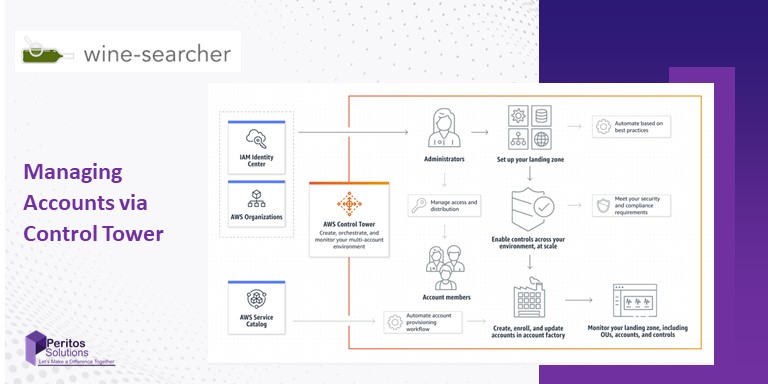
Technology and Architecture of AWS Control Tower Setup
- Read about the key components defining the AWS Control Tower architecture for Wine-Searcher
Technology / Services Used
- We used AWS services to set up the following:
- Cloud: AWS
- Organization setup: Control Tower
- AWS SSO integrated with Azure AD credentials
- Policies setup: AWS Service Control Policies (SCPs)
- Templates created for common AWS services
Security & Compliance
- Tagging policies
- AWS Config for compliance checks
- NIST compliance
- Guardrails
- Security Hub
Network Architecture
- Site-to-site VPN using Transit Gateway
- Distributed AWS Network Firewall
- Monitoring with CloudWatch and VPC Flow Logs
Backup and Recovery
- Infrastructure follows AWS Well-Architected Framework with multi-zone availability and 99.99% uptime
Cost Optimization
Alerts and notifications are configured to monitor AWS costs and prevent budget overruns.
Code Management & Deployment
CloudFormation scripts for stack sets and AWS service provisioning were handed over to the client.
Challenges in Implementing AWS Control Tower Setup
- Landing Zone Drift
- Role Drift
- Security Hub Control Drift
- Trusted Access disabled
Support
- 1 month extended support
- A template for Cloud formation stack to create more AWS resources using the available stacks
- In addition, Screen sharing sessions with demo of how the services and new workloads can be deployed.
Peritos is a team of highly skilled developers, technical experts, and delivery managers. We’ve been very impressed with their commitment. Their developers and delivery managers have conducted themselves with professionalism and diligence at all times, and the quality of the work they have performed has been excellent. Many times, they proposed better solutions, which resulted in better and faster products. Peritos is a reliable AWS Partner. You can trust and be satisfied.

“We are very happy with the results of this major IT project with Peritos Solutions. Their staff gained a good knowledge of our business and processes. They were able to work with many of our diverse team members and launch Business Central ERP on time and on budget according to our requirements. We will be using them again for future projects and additional development actions. Thank you!”

The project was completed on time and as per the agreed budget. The communication was excellent, as was the dedication to quickly turning around the required report development. The overall experience was good, and I would definitely work with the Peritos Team again.
 Recent Home
 Recent Home
 Recent Home
 Recent Home


Peritos is a team of highly skilled developers, technical experts, and delivery managers. We’ve been very impressed with their commitment. Their developers and delivery managers have conducted themselves with professionalism and diligence at all times, and the quality of the work they have performed has been excellent. Many times, they proposed better solutions, which resulted in better and faster products. Peritos is a reliable AWS Partner. You can trust and be satisfied.
“We are very happy with the results of this major IT project with Peritos Solutions. Their staff gained a good knowledge of our business and processes. They were able to work with many of our diverse team members and launch Business Central ERP on time and on budget according to our requirements. We will be using them again for future projects and additional development actions. Thank you!”
The project was completed on time and as per the agreed budget. The communication was excellent, as was the dedication to quickly turning around the required report development. The overall experience was good, and I would definitely work with the Peritos Team again.
Recent Home
Recent Home
Recent Home
Recent Home
Peritos is a team of highly skilled developers, technical experts, and delivery managers. We’ve been very impressed with their commitment. Their developers and delivery managers have conducted themselves with professionalism and diligence at all times, and the quality of the work they have performed has been excellent. Many times, they proposed better solutions, which resulted in better and faster products. Peritos is a reliable AWS Partner. You can trust and be satisfied.
“We are very happy with the results of this major IT project with Peritos Solutions. Their staff gained a good knowledge of our business and processes. They were able to work with many of our diverse team members and launch Business Central ERP on time and on budget according to our requirements. We will be using them again for future projects and additional development actions. Thank you!”
The project was completed on time and as per the agreed budget. The communication was excellent, as was the dedication to quickly turning around the required report development. The overall experience was good, and I would definitely work with the Peritos Team again.
Recent Home
Recent Home
Recent Home
Recent Home


