

Executive Summary
Tonkin + Taylor provides environmental and meteorological services, with a focus on high-resolution meteorological data for applications such as air quality analysis, weather forecasting and climate risk assessment. Its offerings are built on advanced data modelling using the Weather Research and Forecasting (WRF) model.
Peritos Solutions developed Atmosolve, a custom AWS product that runs the WRF model on a high-performance computing (HPC) cluster, automates data processing and lets external customers purchase meteorological datasets through an easy-to-use online platform.
Project outcomes
Results & Impact
WRF on AWS
HPC cluster setup
100% orchestration
Automated workflows
80% improved
Compute efficiency
40% reduced
Processing time
Background
The WRF model generates highly detailed meteorological datasets, but it needs significant computational resources to do so. Tonkin + Taylor wanted to commercialise these datasets and make the most of their broad applicability across multiple disciplines.
Peritos was engaged to build a comprehensive system that could run the WRF model efficiently on an HPC cluster, automatically create and manage cluster jobs when new data requests arrive, and handle data resolution adjustments without manual effort.
The system also needed to give customers a seamless online experience, from selecting data parameters to downloading their processed data.
Challenge
The WRF model’s computational demands made running it on the customer’s existing local infrastructure impractical. The solution had to handle large-scale data generation efficiently while keeping costs optimised.
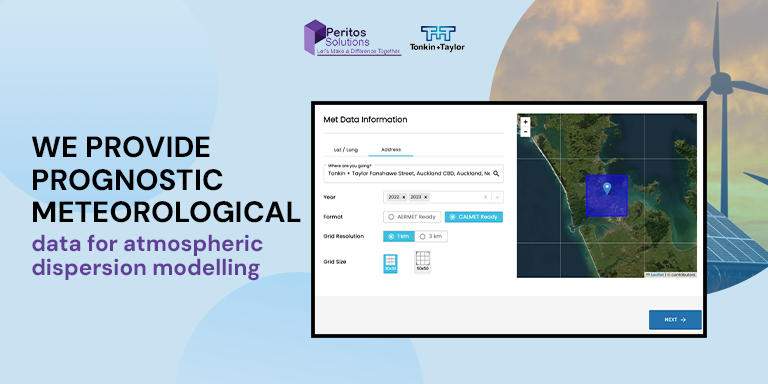
To monetise the data, Tonkin + Taylor also needed an intuitive, user-friendly portal where external users could select regions, adjust data resolution and purchase datasets. The portal had to handle secure transactions reliably, which was essential to the success of the business model.
Solution
Peritos implemented AWS ParallelCluster to provide the compute power needed for WRF and WPS processing. A head node manages the compute fleet, and the cluster scales dynamically with demand. Jobs are created and managed automatically by AWS Step Functions and Lambda using Slurm APIs.
The web portal is built with Next.js and hosted on AWS Amplify. It is secured by AWS WAF and Shield, and its APIs are managed through Amazon API Gateway. The backend uses .NET, C# and Python, with PostgreSQL as the database.
Key Solution Capabilities
- Data Requests and Pricing: Input data parameters, request pricing and complete purchases online.
- Secure Payments: Process transactions through Stripe integration.
- Automated Processing: Trigger the workflow on payment confirmation and run WRF and WPS on ParallelCluster.
- Workflow Orchestration: Coordinate Lambda functions, state transitions, retries and errors with Step Functions.
- High-Performance Storage: Use FSx for Lustre for processing, with Amazon S3 and Aurora DB for storage and transactions.
- Post-Processing: Run additional processing on EC2 instances before final storage.
- Notifications: Notify users via SNS with a link to download their processed data.
Approach
The platform integrates Google APIs, Stripe, Auth0 for authentication, SendGrid for email and Slurm APIs for cluster job management.
Peritos also strengthened Tonkin + Taylor’s FinOps capabilities by designing a cost-efficient, scalable architecture. Compute was optimised with ParallelCluster, serverless automation was implemented with Lambda and Step Functions, and Amazon S3 and FSx for Lustre provide cost-effective storage.
As a result, Tonkin + Taylor can scale on demand, reduce infrastructure costs and gain visibility into cloud spending. This enables efficient monetisation of meteorological data while keeping operational expenses under control.